
Entrepreneurship Center Management
Advance Your Skills in Entrepreneurship Support
Advance Your Skills in Entrepreneurship Support
The Entrepreneurship Center Management (ECM) Certificate Program is InBIA's comprehensive, practitioner-focused training designed for leaders and staff of incubators, accelerators, entrepreneurship centers, and ecosystem-building organizations.
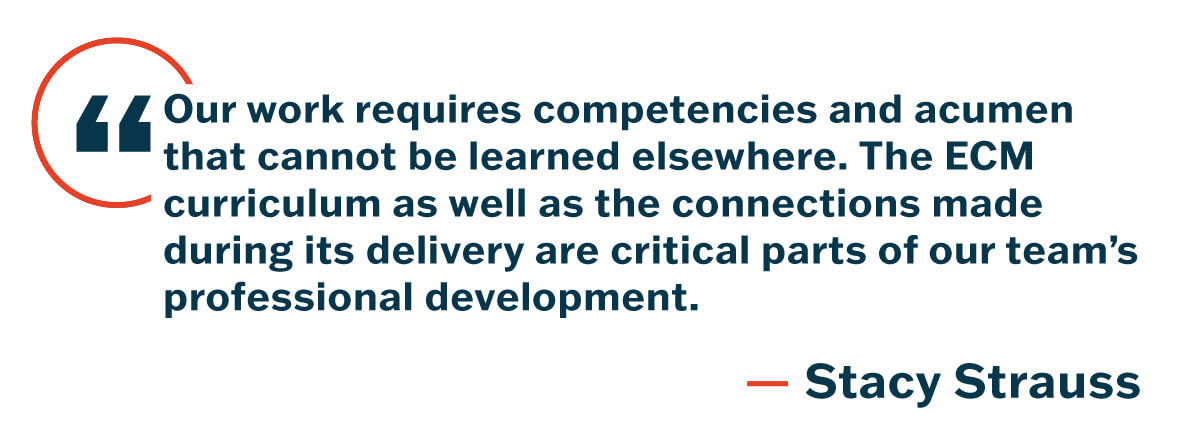
Delivered as a four-course series, the program provides a practical, end-to-end understanding of how to design, operate, and sustain high-impact entrepreneur support organizations (ESOs).
Participants move from understanding entrepreneurship ecosystems and community roles, to building effective programs for entrepreneurs, to mastering financial sustainability and operations, and finally to establishing strong governance, policies, and performance measurement systems. Together, the four courses equip participants with the frameworks, tools, and real-world insights needed to strengthen their ESO's effectiveness and long-term impact, as well as their own professional skills and credibility.
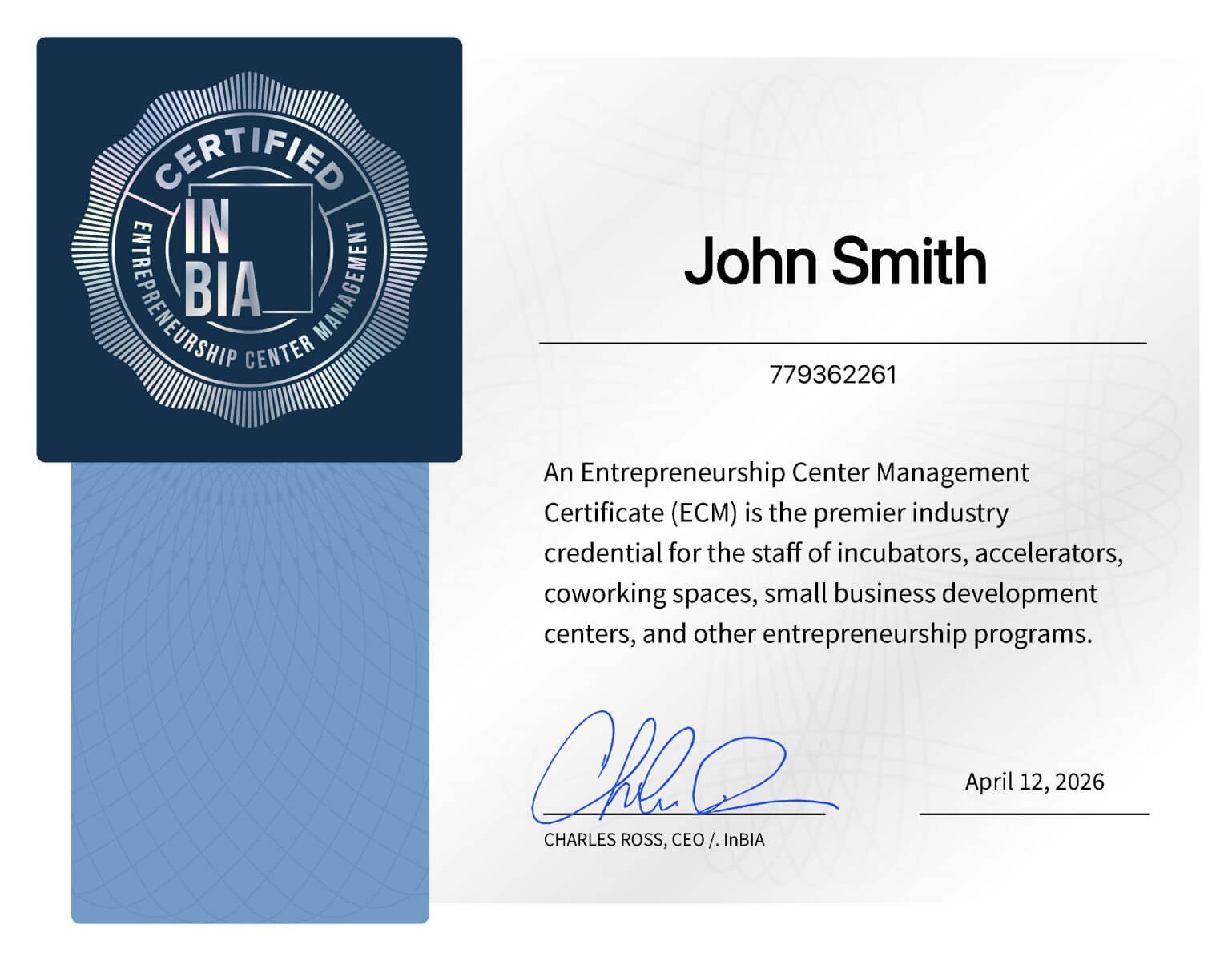
Participants who register for the full ECM program save money by bundling courses, gain access to special benefits, and move through a structured learning experience that builds progressively. They have access to course materials, assignments, and online discussions through InBIA's I-Connect platform and will receive an official ECM Certificate upon completion of the program.
Registration for Fall ECM is Now Open
Course Descriptions
This course introduces participants to the foundational concepts of entrepreneurship ecosystems and the critical role ESOs and ecosystem builders play in helping those ecosystems thrive by being effective connectors, conveners, and champions for entrepreneurs in the community. Through practical frameworks, ecosystem mapping, and applied assignments, participants gain clarity on their organization's mission, target founder segments, and value proposition while learning how to identify gaps they can solve within their local ecosystem.
Participants will learn how to:
- Explain the structure and function of entrepreneurship ecosystems
- Identify key players, organizations, and thriving ecosystem examples
- Map their local entrepreneurship ecosystem
- Identify gaps and opportunities their ESO can address
- Define their target founder segment
Additional topics include:
- Identifying and mapping local business resources and capital providers
- Developing a local entrepreneur resource and capital map to support effective navigation
- Analyzing gaps, overlaps, and opportunities within the local ecosystem
- Synthesizing ecosystem and needs data to inform community-based entrepreneurship strategies
- Building trusted relationships with resource and ecosystem partners
This course focuses on how ESOs can design, deliver, and sustain programs that effectively support entrepreneurs while also strengthening the financial and operational health of the organization itself. Building on the seven types of capital and the three purposes of programs and services, this course explores how to tailor offerings to meet founder needs at every stage while measuring success through KPIs and key partnerships. Participants will examine practical frameworks that deliver real value to founders while reinforcing a sustainable business model for the ESO.
Participants will learn how to:
- Differentiate entrepreneur types and growth stages
- Design programming that teaches diverse entrepreneurs and broader communities
- Guide entrepreneurs toward appropriate next steps for funding and growth
- Design a portfolio of programs and services
- Apply customer discovery and risk-reduction frameworks
- Evaluate program delivery and pricing models
Additional topics include:
- Conducting a community needs assessment to understand entrepreneur challenges and barriers
- Understanding which types of capital are appropriate at different stages of entrepreneur readiness
- Identifying and engaging partners for co-hosted and co-owned programming
- Curating relevant speakers, content, and programming through partnerships
- Developing joint events that expand reach through shared audiences
- Creating a joint event plan with clearly defined partner roles and outcomes
- Reducing participation barriers related to time, language, culture, and trust
This course focuses on the financial and operational foundations required to build and sustain a successful ESO. The content helps participants understand how ESOs generate revenue, manage costs, structure pricing, and design business models that balance mission impact with long-term financial sustainability. Participants explore real-world revenue streams — from programmatic income and membership to grants, sponsorships, and in-kind support — alongside cost structures, staffing models, and key resources and infrastructure. Using practical frameworks, participants will gain the skills and tools needed to make informed decisions that strengthen organizational resilience, accountability, and effectiveness.
Participants will learn how to:
- Analyze ESO business models and revenue streams
- Develop pricing, packaging, and financial strategies
- Apply budgeting, forecasting, and cost-management practices
- Design effective operational and staffing structures
Additional topics include:
- Recruiting, onboarding, and retaining volunteers with clear roles and expectations
- Developing operational structures that support volunteer-powered programs
- Securing local sponsors, community funders, and in-kind support
- Building an annual operating plan that supports program continuity
This course focuses on the operational policies, governance structures, and outreach strategies that enable ESOs to run effectively and serve founders with consistency. Building on the completed ECM Canvas, participants examine the key policy areas, space management practices, and multi-channel outreach strategies needed to launch and sustain a high-performing entrepreneurship center. The course culminates in a Mock Funding Pitch Competition where participants pitch their ESO initiative to a live panel of judges and receive real-time feedback.
Participants will learn how to:
- Develop policies for outreach, intake, graduation, and lease agreements
- Apply space management planning and best practices
- Design organizational governance strategies
- Build and execute a multi-channel outreach strategy
Additional topics include:
- Establishing board structure, roles, and recruitment practices
- Creating consistent intake and graduation policies that reflect the ESO's mission and target founder segment
- Completing the full strategic plan and presenting to a mock funder panel
Through the ECM program, participants will learn how to:
- Understand and apply entrepreneurship ecosystem concepts and clarify an ESO's role in the community
- Identify, map, and engage key stakeholders, partners, and ecosystem actors
- Design programs and services that align with entrepreneur needs, growth stages, and the seven types of capital
- Build sustainable business models using earned revenue, sponsorships, grants, and in-kind support
- Manage finances, pricing, staffing, and operations to support long-term viability
- Establish effective governance structures, policies, and board relationships
- Implement clear outreach, intake, graduation, and lease agreement policies
- Develop and execute a multi-channel outreach strategy that expands reach and builds community trust
- Build a complete strategic plan for their ESO initiative through the ECM Canvas — and pressure-test it by pitching to a live Mock Funding Panel and receiving expert feedback
This program is ideal for ESO directors and staff, incubator and accelerator managers, ecosystem builders, economic development professionals, and university—or community-based program leaders seeking a practical, globally informed foundation in managing an ESO.